


If you’re an ISTP, you probably do not struggle with figuring things out once the problem is real. You can stay calm in practical situations, notice what is happening, and move quickly when there is a tool to use, a system to fix, or a concrete result to produce.
The harder part is often starting before the situation feels urgent. A task that is too abstract, too far away, or too full of meetings and explanations can sit untouched until the deadline gets close enough to feel real. Then your focus switches on. You cut through the noise, solve the immediate problem, and wonder why you could not access that energy earlier.
That pattern does not automatically mean you are lazy or unmotivated. It may simply mean the task does not match the conditions that help you focus. That pattern does not automatically mean you are lazy or unmotivated. It may simply mean the task does not match the conditions that help you focus.
Hour-by-hour schedules, long planning rituals, and constant check-ins can drain the independence and hands-on momentum that help you perform well. A better system gives you flexibility, clear finish lines, enough novelty to stay engaged, and practical pressure before the real crisis arrives.
These productivity tips are built around one central idea: your ability to respond under pressure is a strength, but it becomes more useful when you turn it into a repeatable system instead of waiting for urgency to appear on its own.
In This Post
This article will show you how to:
- Use deadline compression without creating unnecessary panic.
- Keep repetitive work interesting enough to finish.
- Choose tools that match your hands-on, practical working style.
- Protect real downtime so your focus has a chance to reset.
- Spot the popular productivity advice that may backfire for your personality type.
- Adjust your system for field work, remote work, desk work, or freelance work.

Why Generic Productivity Advice Doesn’t Always Stick
Many productivity systems assume you need more structure, more reminders, and more forward planning. That can work for some people. For this personality type, too much structure can make a task feel less like a challenge and more like a cage.
This personality type is often present-focused, practical, and interest-driven. In type-specific terms, the pattern points toward internal logic, problem-solving, real-time awareness, movement, tools, and concrete experience. In everyday life, you may be at your best when you can see the problem, test the fix, and adjust as you go.
That is why vague goals such as “get organised,” “work on the project,” or “build better habits” may not create much traction. They do not give your mind anything tangible to engage with. The task becomes real when there is a constraint, a visible result, a tool in your hand, or a problem that needs solving now.
So the goal is not to force yourself into a rigid planner personality.
The goal is to design a system with enough freedom to keep your autonomy intact and enough pressure to stop important work from drifting.
Once you understand that pattern, the productivity advice becomes more practical. These tips are not random hacks. They are designed around the way you naturally focus, react, avoid unnecessary structure, and get moving when a problem finally feels real.
How ISTPs Can Be More Productive
1. Turn Deadlines Into Manufactured Crises

You may already know that your focus sharpens when something becomes urgent. The problem is relying on the real deadline to create that urgency for you. By then, the work may be rushed, the options may be narrower, and the stress may be higher than it needed to be.
Instead, use deadline compression. Take the real deadline and create a shorter, self-imposed finish line that feels concrete. If a report is due Friday, make Wednesday at 3 p.m. the finish line for the first complete version. If a repair, design, proposal, or admin task has no external pressure, give it a visible timer, a narrow work window, and a specific output.
For example, “work on my portfolio” is too soft. “Publish one finished project page by 4 p.m.” gives your mind a practical target. “Sort out finances” may drag for weeks. “Categorise the last 30 transactions in 25 minutes” creates a small, solvable crisis.
Research on procrastination and deadlines supports the basic idea that self-imposed deadlines can help people control delay, although they are not always set optimally. A study in Psychological Science found that people do use self-imposed deadlines as precommitment devices, but externally imposed deadlines can sometimes produce stronger performance. The research was not specific to ISTPs, but the principle is useful here: an earlier deadline works best when it creates a clear commitment rather than another date you can ignore.
The practical lesson is simple: do not just set an earlier deadline; make the finish line visible, specific, and slightly uncomfortable.
A good deadline has three ingredients:
(1) A clear result.
(2) A short time container.
(3) Freedom inside the container.
Decide what must be finished, set the clock, then avoid micromanaging every step. Save check-ins for the finish line, not the process.
2. Keep the Work Itself Interesting
Novelty matters. Repetitive work can feel harder than complex work because it does not give your mind enough to solve. That is why “just be consistent” may sound sensible but still fail in practice. Research on self-regulation in the Journal of Personality and Social Psychology suggests that exerting control can draw on limited regulatory resources, which is another reason to reduce unnecessary friction instead of relying on willpower alone.
One way to handle that is to turn boring work into an efficiency puzzle. Instead of asking, “How do I force myself through this?” ask, “How can I make this cleaner, faster, or less annoying next time?” That small shift gives your thinking side something to improve while your practical side still gets the job done.
Try changing the order, location, or tool involved. Answer admin messages while standing at a counter. Sort errands by route instead of category. Batch tasks by the tool you need: laptop, phone, vehicle, workshop, kitchen, or notebook.
Repetition becomes easier when there is a practical system to test.
3. Choose Tools That Match How You Actually Work
A productivity system only works if you will actually use it when the day gets busy. Often, the simplest tools are the best: a whiteboard, index cards, a visible timer, a short notes app, or a calendar with only the important commitments on it.
The key is visibility.
If a task disappears three screens deep in an app, it may as well not exist.
Keep the next action somewhere you can see it. Put the invoice on the desk. Place the tool by the door. Write the sprint goal on a card. Use your environment as a reminder instead of relying only on alerts.
Batching can also be more effective when it is physical rather than abstract. Instead of grouping tasks as “admin,” “creative,” and “personal,” group them by context: calls to make, places to go, tools to use, things to fix, or errands on the same route. That matches the way practical action often happens in real life.
If you want to test a new app or workflow, use a simple decision rule instead of an arbitrary challenge.
Keep it if it helps you start faster, see the next step clearly, or finish work with less friction.
Drop it if it becomes another place to organise tasks instead of doing them.
4. Protect Real Downtime, Not Just Micro-Breaks

Short breaks help, but they are not the whole story. If you stop working for five minutes while your mind is still solving the task, replaying the problem, or checking messages, you may not actually recover.
Research on psychological detachment from work suggests that mentally switching off during nonwork time is linked to better recovery, lower strain, and stronger well-being. In the Journal of Occupational Health Psychology, Sonnentag and Fritz identified psychological detachment, relaxation, mastery, and control as distinct recovery experiences that help people unwind from work. That may work best when downtime is active enough to hold your attention without becoming another obligation.
That could mean working on a bike, cooking, walking, playing a sport, building something, gaming with clear limits, or doing anything that lets your brain leave the task behind. Passive scrolling may feel like a break, but it often keeps your attention fragmented.
Real downtime gives your focus a reset.
5. Watch for Productivity Advice That Backfires
Some popular productivity advice sounds sensible but works against your natural rhythm.
(1) Hour-by-hour time blocking: Useful for appointments, often too rigid for real work. Use short sprints and outcome blocks instead.
(2) Guilt-based habit streaks: A missed day can make the whole system feel pointless. Track useful completions, not moral failure.
(3) Frequent check-ins: Too many updates can interrupt the flow needed to solve the actual problem. Agree on finish-line check-ins where possible.
(4) “Eat the frog” every morning: Starting with the worst task may work for some people, as an ISTP your energy may switch on faster when you begin with a small practical win.
6. Adjust the Approach for Your Work Setting
Not everyone with this personality pattern has the same kind of work, so the system should flex with the job context. In hands-on, field, technical, or skilled trades roles, the work itself may already provide movement, changing problems, and practical feedback. Your main challenge may be admin, documentation, or long-term planning around the work.
In desk-based or remote roles, the risk is different. The work can become too abstract and too still. Build in deliberate variety: change locations, use visible task boards, create short delivery windows, and attach abstract tasks to concrete outputs.
In freelance or highly autonomous work, the freedom can be useful and dangerous. You may not have enough external pressure to activate your best focus, so manufactured deadlines become especially important.
Create client-like finish lines even for personal projects.
7. Design Around Your Need for Independence
Autonomy is not just a preference; it affects motivation. In an, Deci, Olafsen, and Ryan link autonomy, competence, and relatedness with stronger autonomous motivation, higher-quality performance, and wellness. For this personality type, that means productivity improves when structure supports action without turning into constant control.
Autonomy is not just a preference; it affects motivation. In an Annual Review of Organizational Psychology and Organizational Behavior review, the authors link autonomy, competence, and relatedness with stronger autonomous motivation, higher-quality performance, and wellness. You may notice this general tendency happening in yourself – if so, there is something practical you can do.
If you work with a manager or team, try negotiating around outcomes. Instead of daily process check-ins, suggest a clear deliverable and a check-in after the sprint. Instead of being available for interruptions all day, batch collaboration into set windows. Written updates can also work better than frequent meetings when the goal is simply to show progress.
A Simple Weekly System for the ISTP Brain
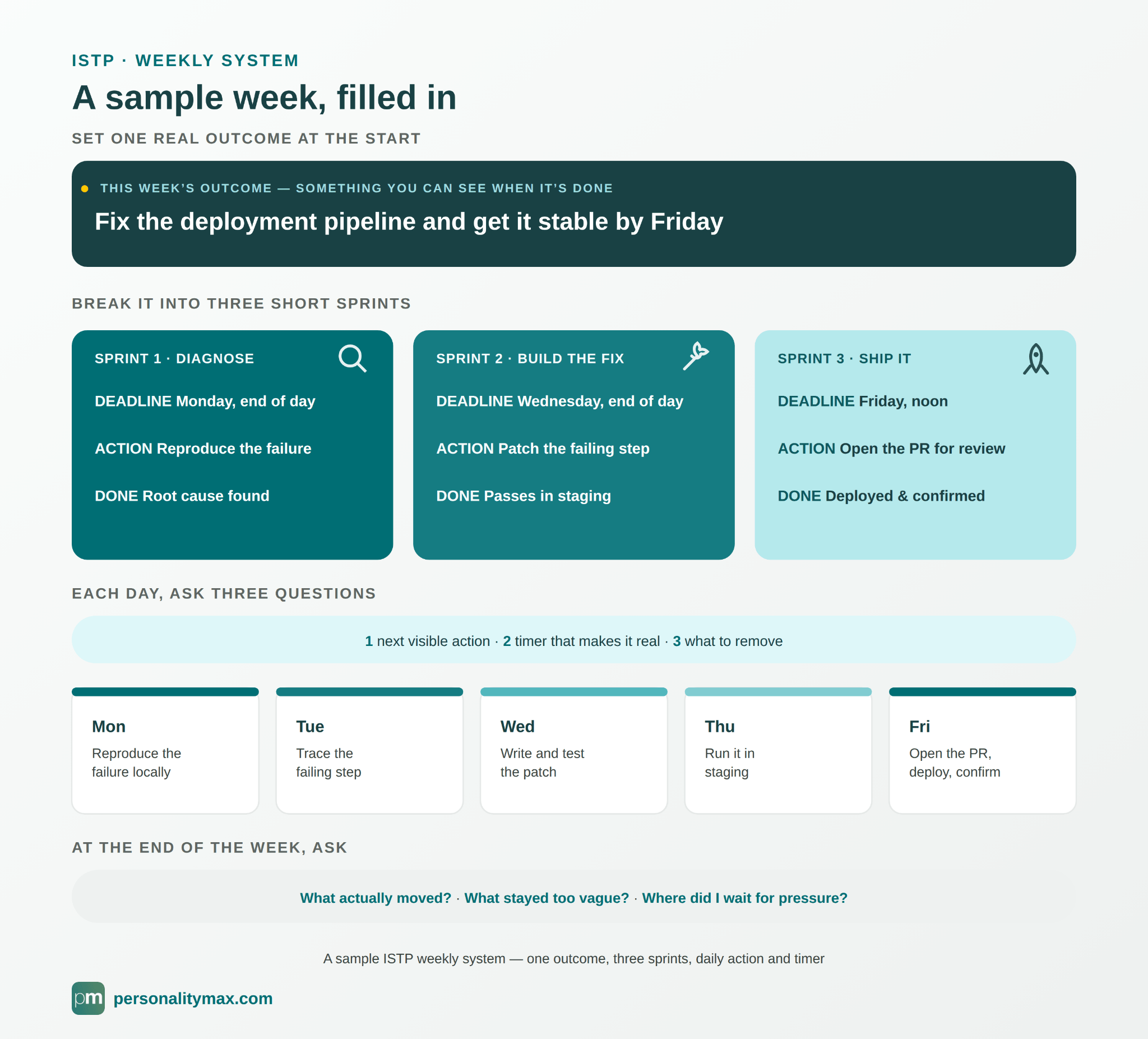
At the start of the week, choose one real outcome. Not a theme, not a mood, and not a huge identity shift. Pick something you can see when it is done: send the proposal, repair the problem, publish the page, finish the module, close the admin backlog, or make the decision.
Then break that outcome into three short sprints. Each sprint needs a deadline, a visible next action, and a finish line. Leave the steps flexible. You are not trying to script the whole week; You are creating enough structure to make starting easier while leaving room to adjust your approach.
Each day, ask:
(1) What is the next physical or visible action?
(2) What timer will make it real?
(3) What can I remove so I can focus?
At the end of the week, ask what actually moved, what stayed too vague, and where you waited too long for pressure to appear.
Productivity Questions, Answered
What is the best productivity system for ISTPs?
The best system is flexible, visible, and built around short bursts of practical pressure. It should show you the next concrete action without forcing you into a rigid routine. Think clear finish lines, simple tools, and enough freedom to decide how the work gets done.
Are ISTPs naturally good at time management?
ISTPs can be very effective with time when the task is practical, urgent, and clearly defined. They may struggle more with open-ended planning, repetitive routines, and distant deadlines. The best time management system for this type keeps tasks visible, concrete, and flexible.
Why do ISTPs procrastinate?
Procrastination often happens when the task feels too abstract, too repetitive, or too disconnected from immediate action. Instead of treating that as a character flaw, make the task more concrete: shorten the deadline, define the output, use a timer, and make the first step visible.
How can ISTPs stay focused?
Focus usually improves when the task has a real-world shape. Define the output, shorten the work window, remove extra choices, and make the next step visible. If your attention drops, add a practical constraint: a timer, a tool, a location change, or a specific problem to solve.
Do ISTPs need routines?
Usually, yes, but the routine should be light. A useful routine gives you a repeatable starting point without controlling every step. For example, you might begin each work block by choosing one visible outcome, setting a short timer, and clearing the tools you need.
Are ISTPs suited to remote work?
They can be, especially when remote work provides autonomy and fewer unnecessary interruptions. The challenge is that fully desk-based remote work can remove the hands-on variety that helps this type stay engaged. Remote productivity works best with movement, visible goals, practical sprints, and clear stop points.
Do ISTPs work well under close supervision?
Usually, they work better when they have a clear outcome and room to choose the method. Close supervision can feel intrusive if it focuses on process instead of results. Outcome-based check-ins are often more useful than constant monitoring.
What should ISTPs do when plans change?
Use the change as new information rather than proof that the plan failed. Keep the outcome steady if it still matters, then adjust the route. Your strength is adapting in real time, so the goal is not to protect the original plan at all costs. It is to reconnect with the next practical move.
The Bottom Line
The strength at the centre of this article is your ability to respond clearly when the situation becomes real. That same strength can become a trap when important work stays vague until pressure forces action. The answer is not to become rigid or over-scheduled. It is to create practical pressure earlier, while still protecting the independence and hands-on problem-solving that help you do your best work.
When you make the work visible, give it a clear finish line, and leave yourself room to choose the method, productivity becomes less about forcing a new personality onto yourself and more about using the way you already operate with more intention.
Read this Next






Mark is a productivity coach with 3 decades of coaching experience. His focus lies on personalized productivity coaching, where he uses PersonalityMax tests in his daily work. Mark is based on South Africa.