
If you’re an ENFJ, you probably do not struggle with caring. You notice when someone is overwhelmed. You remember the task a teammate forgot. You can see the bigger goal behind the meeting, the project, or the cause, and you often feel personally responsible for helping everyone get there.
That strength can make you highly productive. It can also become the reason your own priorities keep slipping. You sit down to finish focused work, then answer one message because someone might need you. You agree to one extra favour because it will only take a few minutes. You stay late because the team is under pressure. Soon your calendar is full, your energy is thin, and the task that mattered most is still waiting.
That is why generic productivity advice often misses the mark. A rigid schedule may look good on paper, but it falls apart the moment a real person asks for help. A longer to-do list may make you feel organised, but it can also collect everyone else’s needs alongside your own.
For many ENFJs, managing time also means learning when a problem is yours to solve and when it isn’t.
These productivity tips are built around one central idea: your care for people is not the problem, but it needs boundaries, recovery, and a simple structure strong enough to protect what matters.
In This Post
This article will show you how to:
- Understand why ENFJs can look organised while privately feeling overextended.
- Build a system around energy, relationships, and recovery instead of willpower alone.
- Prioritise without feeling as if every choice lets someone down.
- Use simple scripts to say no without over-explaining.
- Create a weekly template that turns care, vision, and structure into sustainable progress.
Why Generic Productivity Advice Doesn’t Always Stick
Many productivity systems assume the main problem is laziness, distraction, or lack of discipline. Through an ENFJ lens, the issue is often different. You may have plenty of drive, especially when your work supports people, improves a team, or moves a meaningful mission forward.
The problem is that your motivation can be closely tied to other people. A time block can collapse when someone needs encouragement. A focused morning can disappear into a team concern. A quiet evening can turn into planning, helping, checking in, and mentally replaying what everyone else needs tomorrow.
So the goal is not to become colder, less helpful, or less available.
The goal is to decide when and where you give your time. A useful time management system should leave room for other people without letting their needs take over your day.
Productivity works best when it turns care into a clear plan, protects energy before resentment builds, and makes space for both meaningful people-work and focused solo work.
Start With the Way Your Mind Actually Works
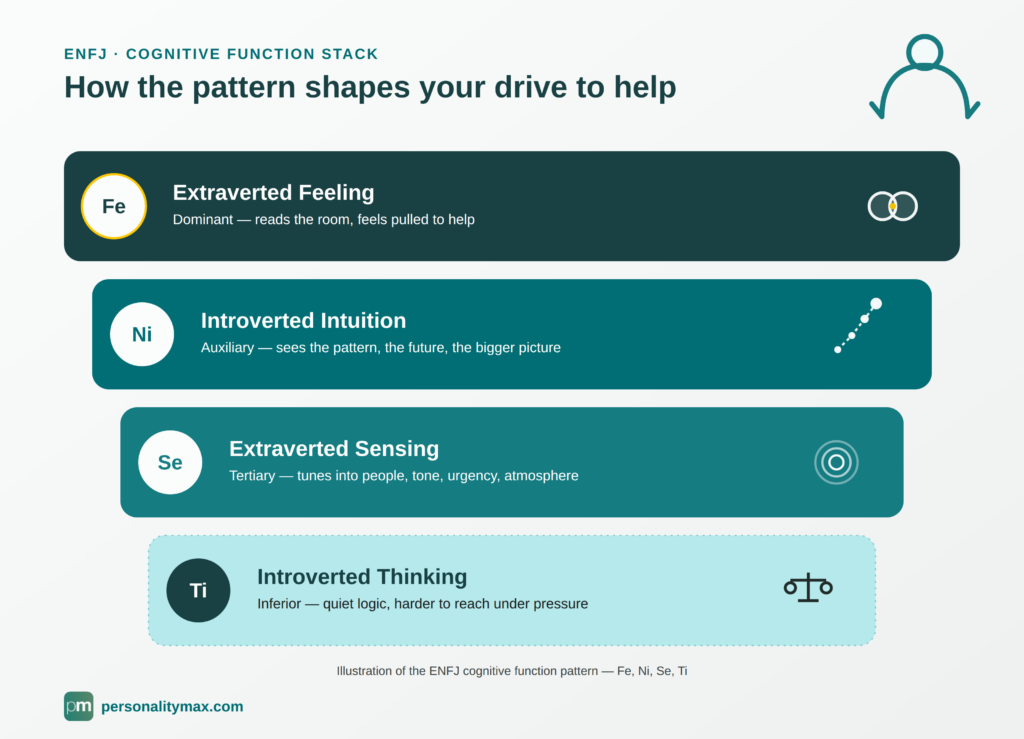
In the ENFJ cognitive-function pattern, Extraverted Feeling, or Fe, often leads. In everyday life, that can look like reading the room quickly, noticing what people need, and feeling pulled to respond. ENFJs tend to be empathetic and people-oriented, with a strong drive to help others grow, which is a powerful strength when it is directed well.
Your auxiliary function, Introverted Intuition, or Ni, pulls you toward patterns, future outcomes, and long-range meaning. This can make you excellent at seeing what a team, family, or project could become. The trade-off is that daily details may feel less interesting than the larger vision.
Your tertiary Extraverted Sensing, or Se, helps you tune into the outside world, people, places, tone, urgency, movement, and atmosphere. It can make collaborative work feel alive. But under pressure, the constant stream of external needs can keep you reacting instead of choosing.
Introverted Thinking, or Ti, sits lower in this function stack. This may help explain why stepping back from the emotional side of a decision can sometimes feel difficult. You may know logically that you cannot do everything, then still feel guilty when someone asks.
Once you understand that pattern, the advice becomes more practical. These are not random hacks. They are ways to keep your care for people from turning into constant interruption, overcommitment, and quiet burnout.
How ENFJs Can Be More Productive
1. Map Your Energy Before You Plan Your Week
Before you build a schedule, notice when different kinds of work feel easiest. You may have different energy for focused thinking, people-facing work, and emotional processing. Treat those as separate resources.
An ENFJ-friendly system should make room for connection without allowing every request to become urgent.
For two weeks, jot down three quick notes each day: when your thinking felt clearest, when conversation felt energising, and when you started feeling emotionally full. You may discover that mornings are best for writing or strategy, mid-morning works well for meetings, and late afternoon is better for admin. Or your pattern may be different.
The point is not to create a perfect routine. It is to stop putting your most demanding work into the hours when you are already drained from absorbing everyone else’s needs.

2. Prioritise Without Turning Every Choice Into a Moral Decision
You may find prioritising difficult when the list is rarely just your own. Your tasks, your team’s needs, a friend’s problem, a family expectation, and a cause you care about can all feel important at the same time.
Use a simple four-box triage. Do urgent and important work first. Schedule important work that is not urgent. Delegate urgent work that does not need you specifically. Decline or remove work that is neither urgent nor important.
If that sounds too clinical, reframe it this way: prioritising is not choosing who matters. It is choosing where your limited energy can do the most good. Research on work-related overcommitment in the International Journal of Environmental Research and Public Health links overcommitment and difficult-to-switch-off work thoughts with fatigue, burnout, and lower well-being, which is why clear decisions matter before the list becomes emotional noise.
A useful question is:
“Will this still matter if I do it well next week instead of badly today?”
That gives you a little distance from the guilt of not doing everything immediately.
3. Use Scripts So Boundaries Don’t Become a Debate
Saying no can feel like creating distance. A script helps because it gives you something to say before you are put on the spot.
Try:
“I can’t take this on today, but I can look at it on Thursday.”
Or:
“I want to give this proper attention, and I do not have the space to do that well this week.”
For a bigger workload conversation, try:
“I can do A or B well by Friday. Which one should I prioritise?”
Boundaries work best when they are kind, clear, and short.
4. Batch Messages So Other People’s Needs Don’t Run the Whole Day
Messages are not neutral when you are naturally tuned in to people.
A notification can feel like a person standing at your desk asking for help.
That is why constant checking can quietly train your day around responsiveness instead of progress.
Set two or three message windows instead of checking all day. Research from UC Irvine found that removing work email reduced screen switching and stress, which supports a simple rule for people-oriented productivity: be responsive on purpose, not by reflex. When you process messages, reply, schedule, delegate, or close the loop.

5. Build Structure Into Tomorrow Before Today Ends
You may hold the long-range vision clearly but still lose time deciding what today’s first step should be. A five-minute evening plan reduces that friction. Choose the top three priorities for tomorrow, identify the first task, and decide where people-facing work belongs in the day.
If one task is emotionally heavy, schedule it early. That might be a difficult email, a performance conversation, or a decision that affects someone else. Do it before the day fills with incoming requests.
Use one planner, calendar, or task app. The tool matters less than the habit of linking the big picture to the next concrete action.
The test is simple: when you sit down tomorrow, do you know exactly what to open first?
6. Manage the Environment, Not Just the Calendar
Your workspace is part of your time management system. If the room is noisy, the desk is cluttered, and every app is allowed to interrupt you, your calendar has to fight too many battles at once.
Create visible focus signals. Close the door if you can. Use headphones if you cannot. Set your chat status honestly. Put your phone out of reach during deep work and let people know when you will be checking messages again. That small detail matters because being unavailable can feel rude unless it has a clear purpose.
End each workday with a two-minute reset: clear the surface, write tomorrow’s first task, and close the tabs that belong to today. It sounds small, but it gives your future self a calmer place to start.
You may work better when you separate high-connection work from detailed follow-through. If your best hours are spent in meetings, mentoring, or responding to needs, do not leave careful admin, planning, and decision cleanup for the moment when your social energy is already spent.

7. Review Your Commitments Before You Add More
You may not need a new productivity system as much as you need a clearer view of what you have already promised.
The danger is not usually a lack of care. It is saying yes so naturally that the week becomes crowded before you notice what it costs.
Once a week, review your active commitments and ask four questions: What still needs your direct involvement? What can wait? What can you delegate? Where do you need a clearer boundary?
Do not confuse being responsive with being responsible for everything.
If you spend an hour replying to every message so nobody feels ignored, then avoid the one decision only you can make, the problem is not your tools. It is the habit of letting other people’s urgency outrank your own priorities.
A Simple Weekly Planning System for ENFJs
You do not need a complicated weekly planning system. You need a short check-in that helps you lead your week instead of absorbing everyone else’s urgency.
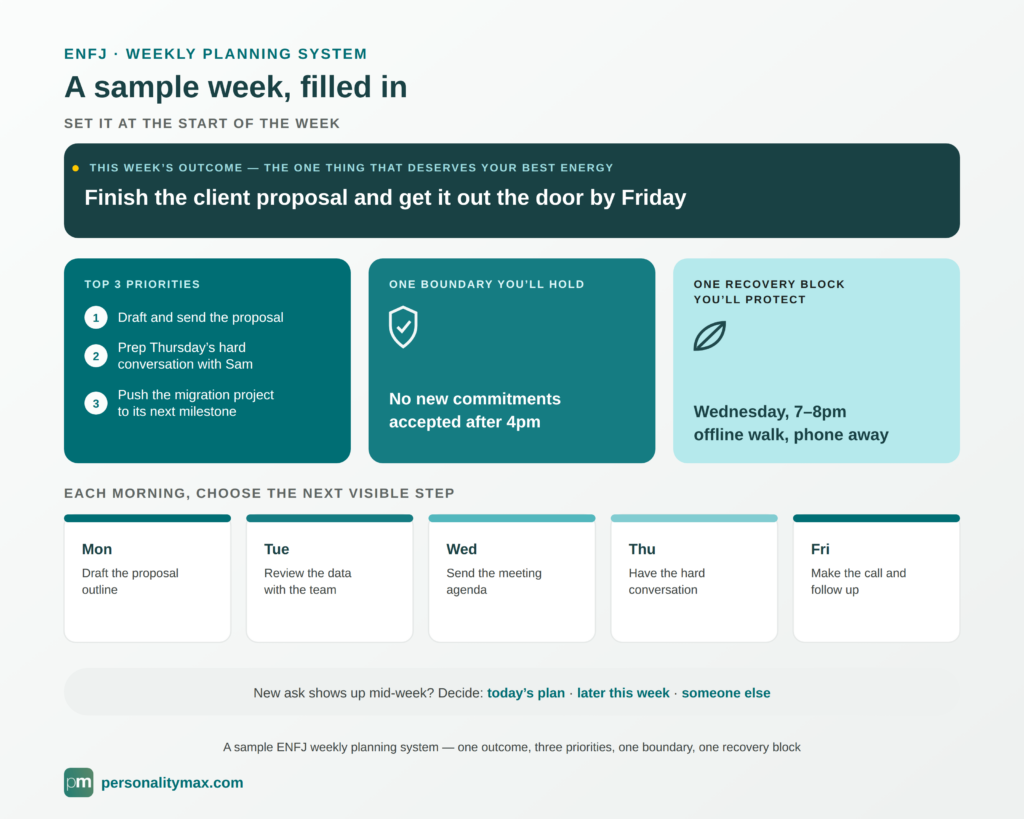
At the beginning of the week, choose one meaningful outcome that deserves your best energy. It might be finishing a proposal, preparing a difficult conversation, completing a project milestone, or creating space for a team decision that has been drifting.
Then write down three things: your top three priorities, one boundary you will hold, and one recovery block you will protect. This gives your own work, your availability to others, and your recovery a place in the week before new demands appear.
Each morning, choose the next useful step. Keep it visible and specific: draft the outline, send the agenda, review the data, make the decision, or ask the clarifying question. If someone else’s need appears, decide whether it belongs in today’s plan, later in the week, or with someone else.
At the end of the week, ask three questions:
- What moved forward because I protected my focus?
- Where did I say yes too quickly?
- What needs to be scheduled, delegated, or released before next week begins?
If the system helps you keep a promise to yourself without becoming less available to the people who genuinely need you, it is doing its job.
Productivity Questions, Answered
Are ENFJs naturally good at time management?
Often, yes, but with a catch. You may be organised when other people are depending on you, and you may track group responsibilities well. The hidden risk is becoming so focused on helping everyone else stay on track that your own priorities, rest, and long-term projects get squeezed out.
Why can productivity still feel difficult if you are so driven?
The problem is usually not a lack of motivation. When your motivation is tied to people, progress, and purpose, more requests can feel worth saying yes to. Without boundaries, the day fills with conversations, favours, follow-ups, and emotional labour while deeper work gets pushed aside.
What is the best productivity system for this personality type?
The best system is simple, visible, and people-aware. It should include a short priority list, protected focus blocks, planned windows for messages and meetings, one clear boundary for the week, and recovery time that is treated as part of the plan rather than an optional reward.
How can you avoid burnout while staying helpful?
Start by separating availability from responsibility. You can care about a person without owning every problem. Build in recovery before you feel desperate for it, use scripts for saying no, and decide in advance which requests you can realistically take on. Sustainable helpfulness depends on pacing, not constant access.
That recovery piece is not just a nice idea. The stressor-detachment model, reviewed by Sonnentag and Fritz, shows that mentally switching off from work during nonwork time is an important recovery experience, while poor detachment is linked with higher strain and poorer well-being. That makes protected downtime part of the productivity system, not something to earn after everyone else is fine.
The Bottom Line
The goal is not to become less caring, less involved, or less responsive. Those qualities can be part of what make you a powerful organiser, mentor, teammate, or leader.
The real skill is learning how to direct that care instead of letting every request, message, and emotional cue decide the shape of your day.
ENFJ productivity is not about forcing yourself into a colder, stricter version of success. It is about protecting the energy you need to think clearly, follow through on meaningful work, and be present for the people who matter. When your week has priorities, boundaries, and recovery built in, your natural warmth becomes more sustainable, not less.