


Every child is a universe of potential, filled with unique ways of seeing and understanding the world. For decades, traditional education systems have focused largely on linguistic and mathematical skills as the primary markers of intelligence. However, this narrow view often overlooks the rich tapestry of talents and capabilities that children possess.
The theory of multiple intelligences, developed by psychologist Howard Gardner, challenges this limited perspective and introduces a broader, more inclusive understanding of human potential. Embracing multiple intelligences in early childhood education is not only transformative, it is essential for unlocking every child’s ability to thrive.
Understanding Multiple Intelligences
The theory of multiple intelligences proposes that intelligence is not a single, fixed trait measured solely by IQ tests, but rather a set of diverse modalities. Gardner originally identified seven intelligences – linguistic, logical-mathematical, spatial, bodily-kinesthetic, musical, interpersonal, and intrapersonal – with naturalistic and existential intelligences added later. These intelligences reflect different ways people learn, solve problems, and express creativity.
By acknowledging these varied intelligences, educators and caregivers can better recognize and support the distinct strengths children bring into the classroom. This approach fosters a deeper engagement with learning, helps children build confidence, and creates a more inclusive educational environment where no child feels left behind.
Why Early Childhood Matters
The early years of a child’s life are a critical window for cognitive, emotional, and social development. During this period, children’s brains are remarkably malleable, and their capacity for learning is immense. Introducing multiple intelligences in early childhood education allows educators to tap into this prime developmental phase by providing diverse learning experiences that resonate with different kinds of intelligence.
Rather than asking all children to fit into a one-size-fits-all mold, a multiple intelligences approach meets children where they are, empowering them to learn in ways that come naturally. This is especially important in early childhood education, where learning should be exploratory, joyful, and adapted to the child’s individual strengths.
Exploring the Intelligences in Practice
Linguistic Intelligence
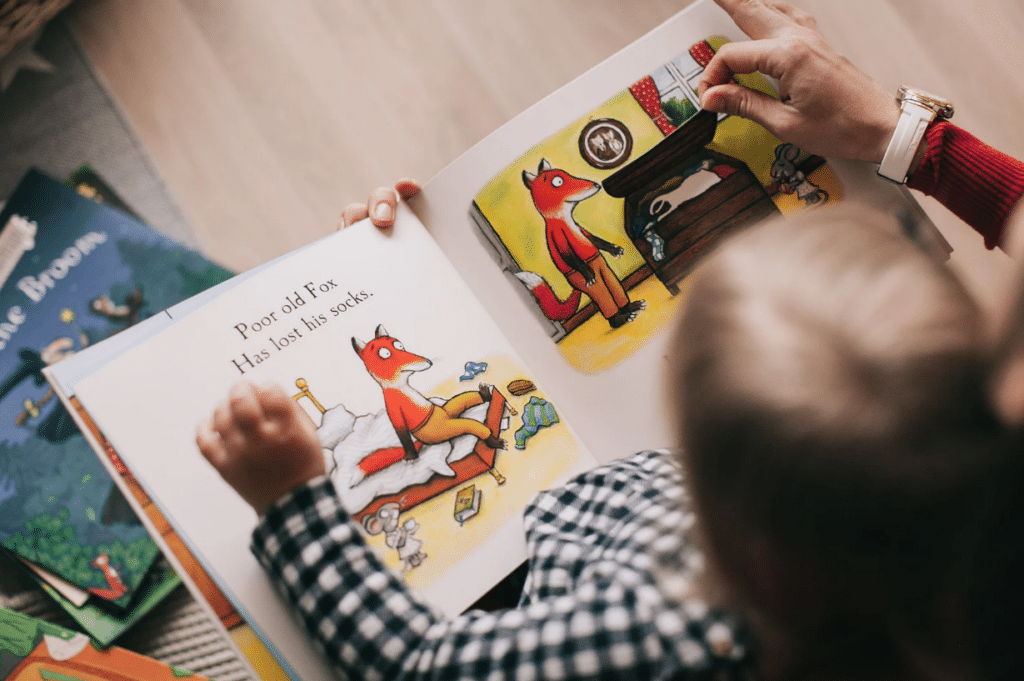
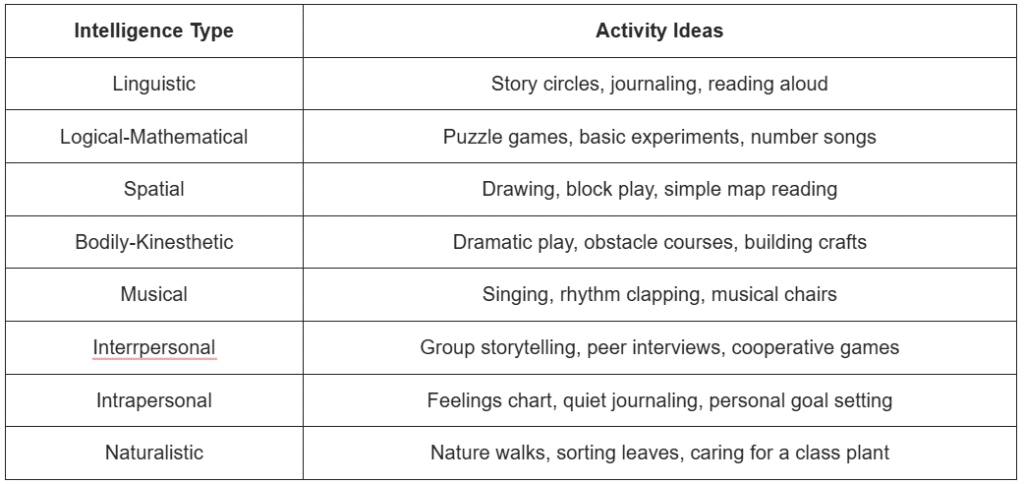
Children with strong linguistic intelligence are drawn to words, reading, storytelling, and language play. In early education settings, these children thrive when given opportunities to engage in reading aloud, rhyming games, and storytelling circles. Creating a print-rich environment and encouraging expressive language helps these children flourish.
Logical-Mathematical Intelligence
These children excel in reasoning, pattern recognition, and problem-solving. They enjoy games involving numbers, puzzles, and cause-and-effect exploration. Introducing simple math concepts through playful activities and hands-on learning supports their intellectual curiosity and analytical thinking.
Spatial Intelligence
Children with spatial intelligence think in images and enjoy visual arts, maps, and building blocks. Activities such as drawing, painting, constructing with LEGO, or using interactive apps can foster their abilities. Integrating visual aids into lessons also supports their comprehension.
Bodily-Kinesthetic Intelligence
These learners need movement to process information. They shine in activities that involve physical coordination, like dance, acting, or hands-on crafts. Educators can support them by integrating movement into lessons—such as counting with jumping jacks or acting out stories.
Musical Intelligence
Musically intelligent children are sensitive to rhythm, tone, and sound. They enjoy singing, listening to music, or playing instruments. Classroom activities that incorporate songs, musical games, or rhythm-based learning can significantly boost their engagement.
Interpersonal Intelligence
These children are socially adept and thrive in group settings. They understand emotions, read social cues well, and enjoy cooperative play. Educators can support them by including collaborative projects, role-playing activities, and opportunities for peer interaction.
Intrapersonal Intelligence
Children with high intrapersonal intelligence are self-aware and reflective. They benefit from quiet time, journaling, and activities that allow introspection. Supporting them involves creating safe spaces for individual exploration and encouraging personal goal setting.
Naturalistic Intelligence
These learners connect deeply with nature and the environment. They enjoy exploring plants, animals, and outdoor settings. Providing access to outdoor play, gardening activities, or nature walks helps them learn in alignment with their interests.

Creating a Holistic Learning Environment
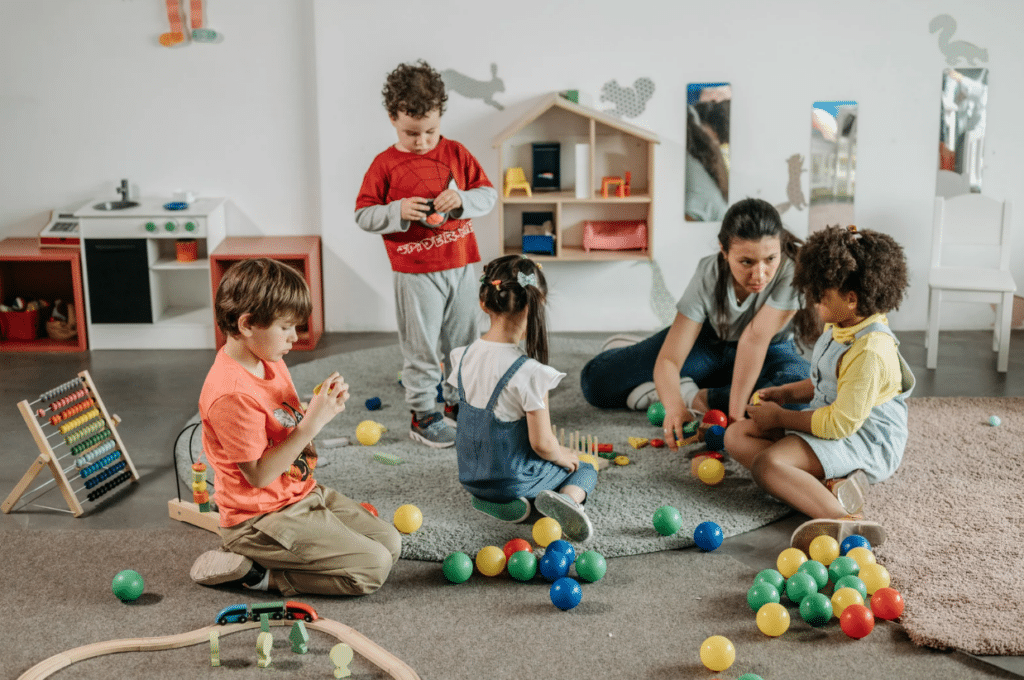
Implementing the philosophy of multiple intelligences in early childhood education requires a shift from rigid, standardized instruction to a more fluid, child-centered approach. Classrooms that honor multiple intelligences offer a variety of learning centers: reading nooks, music corners, building zones, and outdoor areas. Educators act as facilitators, observing children closely to identify their natural inclinations and tailoring activities to support and stretch their developing intelligences.
Rather than labeling children as “smart” in one narrow domain, this model celebrates diverse ways of being smart. It helps children see themselves as capable learners, not just in academics, but across the full spectrum of human potential.
Benefits of a Multiple Intelligences Approach
- Increased Engagement
When children engage with material through their preferred intelligences, they are more likely to stay focused and enjoy learning. - Enhanced Self-Esteem
Recognizing and validating a child’s unique talents builds confidence and fosters a positive self-image from a young age. - Greater Inclusivity
Children who might struggle in traditional learning environments find new avenues for success, reducing feelings of frustration or inadequacy. - Stronger Collaboration
Children learn to appreciate different strengths in others, promoting empathy and cooperative learning. - Lifelong Learning Skills
By nurturing various intelligences, educators equip children with the tools to adapt, problem-solve, and continue learning in a complex world.
Empowering Educators and Parents
The success of multiple intelligences in early childhood education depends on the commitment of adults to observe, listen, and respond to each child’s learning journey. Educators need training to recognize signs of different intelligences and to create adaptive curricula. Parents play a vital role by reinforcing these principles at home – celebrating not only academic achievements but also creativity, empathy, and curiosity.
Resources such as observation checklists, diverse activity guides, and professional development workshops can support educators in this effort. Similarly, engaging parents through conferences, home learning extensions, and regular communication builds a cohesive support system for the child.

Looking Ahead: A Vision for the Future
As education evolves to meet the demands of a changing world, understanding and applying multiple intelligences in early childhood education offers a roadmap for truly transformative learning. It allows us to redefine what success looks like: not just as academic excellence, but as the full realization of a child’s potential across many domains.
Imagine classrooms where music and math intertwine, where gardens teach biology and cooperation, where storytelling builds both literacy and emotional intelligence. In these environments, children are not just passive recipients of information. They are active creators, explorers, and thinkers.
Multiple Intelligences in Early Childhood Education: Cultivating Brilliance from the Start
Incorporating multiple intelligences in early childhood education is more than an instructional strategy. It is a philosophy that honors the richness of human diversity. When we nurture each intelligence with care and intentionality, we send a powerful message to children: your way of learning matters, your strengths are valuable, and your potential is limitless.
By recognizing and supporting multiple paths to knowledge, we lay the foundation for a lifetime of growth, confidence, and joy in learning. Let us embrace this holistic approach and create learning environments where every child can flourish, starting from the very beginning.
Did you enjoy this post? If you found it helpful, feel free to share it with your friends! We’d love to hear your thoughts—reach out to us at contact@personalitymax.com. We’re always happy to answer any questions. 😊
Note: personalitymax.com does not provide financial, legal, or medical advice. Please consider consulting a professional.
Read this Next

Rachel is a content specialist passionate about writing and human interactions. She enjoys collecting and share valuable content with our community, helping members on their own self discovery journey.